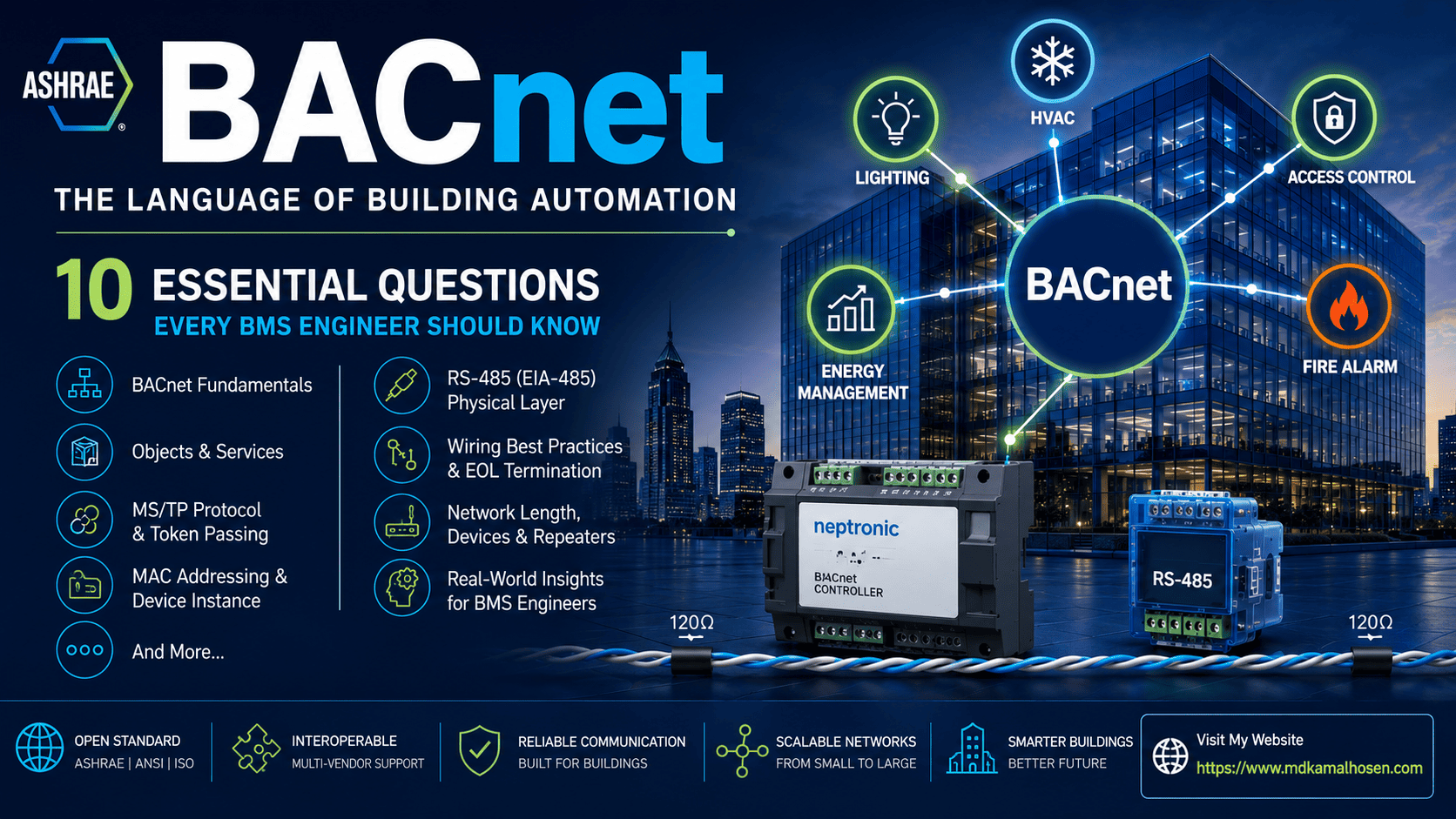
Whether you're a beginner in Building Management Systems (BMS) or an experienced automation engineer, understanding the fundamentals of BACnet is essential. This article covers the most frequently asked BACnet interview and technical questions, including MS/TP communication, device addressing, wiring practices, and network design.
1. What is BACnet, and what are its primary applications?
Answer:
BACnet (Building Automation and Control Network) is an open communication protocol specifically designed for Building Automation Systems (BAS). It is an international standard developed by ASHRAE and approved by ANSI and ISO.
BACnet enables seamless communication between devices from different manufacturers in building automation systems.
Primary Applications
- 🌡️ HVAC (Heating, Ventilation, and Air Conditioning)
- 💡 Lighting Control
- 🔐 Access Control Systems
- 🚨 Fire Detection and Alarm Systems
- ⚡ Energy Management
- 🏢 Smart Building Automation
2. What is the purpose of Objects and Services in the BACnet protocol?
Answer:
BACnet is built around two fundamental concepts:
Objects
Objects represent the current status and properties of a device.
They allow applications to:
- Read values
- Write values
- Monitor device status
- Configure system parameters
Examples include:
- Analog Input (AI)
- Analog Output (AO)
- Binary Input (BI)
- Binary Output (BO)
- Analog Value (AV)
Services
Services define how BACnet devices communicate with one another.
Common BACnet services include:
- ReadProperty – Read an object's value
- WriteProperty – Modify an object's value
- Who-Is – Discover devices on the network
- I-Am – Respond with device information
- SubscribeCOV – Receive change-of-value notifications
3. What is the MS/TP protocol, and how does it function?
Answer:
MS/TP (Master-Slave/Token-Passing) is a BACnet communication protocol that operates over an RS-485 network.
It allows multiple building automation devices to communicate using a token-passing mechanism.
How Token Passing Works
- A device receives the communication token.
- Only the device holding the token is allowed to transmit data.
- After transmitting, it passes the token to the next device.
- The process repeats continuously.
This method prevents communication collisions and ensures reliable network performance.
4. What physical layer standard does BACnet MS/TP use?
Answer:
BACnet MS/TP uses the EIA-485 (RS-485) physical communication standard.
RS-485 provides:
- Long communication distances
- Multi-drop networking
- Excellent noise immunity
- Reliable industrial communication
5. What is the maximum length of an MS/TP network segment, and how can it be extended?
Answer:
An MS/TP network can support:
- Maximum cable length: 4,000 feet (1,200 meters)
- Supported baud rates: 9,600 bps to 100,000 bps
Extending the Network
The network length can be increased by installing RS-485 repeaters.
6. How many devices can be connected to an MS/TP network?
Answer:
The number of supported devices depends on the network configuration.
| Configuration | Maximum Devices |
|---|---|
| Without Repeaters | 64 |
| With Repeaters | 127 |
For larger installations, additional BACnet MS/TP routers should be used to create multiple network segments.
7. What are the recommended wiring guidelines for an MS/TP network?
Answer:
Follow these best practices to ensure reliable communication:
- Use a daisy-chain topology.
- Maintain consistent polarity (A+ to A+, B− to B−).
- Avoid unnecessary untwisting of the cable pair.
- Keep communication wiring away from:
- Power cables
- Variable Frequency Drives (VFDs)
- High-voltage equipment
- Secure cables to minimize vibration and mechanical stress.
Tip: Avoid star or T-topology wiring, as it can cause communication issues.
8. What is the purpose of an End-of-Line (EOL) termination?
Answer:
An End-of-Line (EOL) termination prevents signal reflections that can disrupt RS-485 communication.
Standard Practice
- Install a 120 Ω resistor between A+ and B−.
- Place the resistor only at the two physical ends of the MS/TP network.
Proper termination improves signal quality and network reliability.
9. What is the role of MAC addresses in BACnet MS/TP?
Answer:
A MAC (Media Access Control) address uniquely identifies each device on an MS/TP network segment.
Address Ranges
| Device Type | Address Range |
|---|---|
| Master Devices | 0–127 |
| Slave Devices | 128–254 |
Each device on the same MS/TP segment must have a unique MAC address.
10. How is the Device Instance determined in Neptronic controllers?
Answer:
Neptronic controllers typically use the following Device Instance format:
0153xxx
Where:
- 153 = Neptronic Vendor Identifier
- xxx = Locally assigned MAC address
For example:
| MAC Address | Device Instance |
|---|---|
| 001 | 0153001 |
| 025 | 0153025 |
| 127 | 0153127 |
This convention simplifies device identification during commissioning and troubleshooting.
Key Takeaways
- BACnet is the industry-standard protocol for building automation.
- BACnet MS/TP communicates over RS-485 using token passing.
- Use daisy-chain wiring and proper EOL termination for reliable communication.
- Every device must have a unique MAC address.
- Network length is limited to 1,200 m (4,000 ft) per segment unless extended with repeaters.
- Neptronic Device Instances are based on Vendor ID 153 and the device's MAC address.
Conclusion
A solid understanding of BACnet fundamentals is essential for every BMS engineer, commissioning engineer, controls technician, and system integrator. Mastering concepts such as objects, services, MS/TP communication, addressing, and wiring best practices will help you build more reliable and efficient building automation systems.
If you're preparing for a BMS interview or working on real-world HVAC automation projects, these BACnet fundamentals provide an excellent foundation.
Comments (0)
Comments are reviewed before they appear publicly.
No comments yet. Be the first to share your thoughts.